


Science · Clinical research
From cellular science.
To human studies.
Explore the clinical research behind Lipogen’s CognoLipid™ formulations — across memory, the response to stress and women’s health.
Mood from late summer to winter
Change in LDS symptom score
From intake to circulation
Serum PS as a proportion of total phospholipids (%)
01 · Memory & mood
Research for the years ahead.
Memory performance in the studied subgroup.
Participants with baseline WMS scores above 68 showed a difference favouring CognoLipid™ after three months. This subgroup result should be distinguished from the overall analysis, which did not show a significant between-group difference.
Following mood over time.
In older adults with memory complaints who were not depressed at baseline, mood was assessed alongside memory. Depressive symptom scores increased in the placebo group over the study period, while no significant change was reported in the CognoLipid™ group.
From the capsule to the body.
A single-dose study in eight healthy volunteers measured serum phosphatidylserine over three hours. The relative level peaked at 90 minutes and returned towards baseline by 180 minutes.
This measures PS relative to serum phospholipids, not the percentage absorbed or the onset of a clinical effect.
Study details +
The absorption study used a single dose of 500 mg PS + 400 mg PA, with blood samples every 30 minutes. Memory, mood and absorption charts use approximate values and error bars from the supplied chart reconstruction, not original raw data. Mood comparisons are within each group and do not establish a significant between-group difference.
A three-month, double-blind, placebo-controlled pilot trial studied 300 mg PS + 240 mg PA daily in adults aged 60–80 with memory complaints, without dementia or depression at baseline. Memory was assessed using WMS and mood using LDS. The per-protocol analysis included 31 participants receiving CognoLipid™ and 26 receiving placebo.
Moré, Freitas & Rutenberg · Advances in Therapy · 2014
Read the publication ↗Salivary cortisol response to a stress test
High chronic stress
Adapted from Hellhammer et al. (2014), Figure 1 · CC BY 4.0
02 · Stress response
The science of responding to pressure.
Following the cortisol response.
The supplied graph shows salivary cortisol changes around a laboratory stress test, comparing placebo and the CognoLipid™ formulation. This is a response measured after a period of supplementation, not evidence of immediate relief after one dose.
Measuring the hormonal response.
ACTH response was reduced versus placebo in men with high chronic stress receiving 400 mg PS + 400 mg PA daily (p = 0.010). Psychological stress response and heart-rate outcomes did not differ significantly.
Study details +
Cortisol chart: Values and error-bar limits are reconstructed approximately from the supplied graphic, not original raw data. Measurement times retain the spacing of the supplied figure.
ACTH tab · 2014 trial: The displayed subgroup comparison shows placebo versus 400 mg PS + 400 mg PA daily for 42 days in healthy men with high chronic stress, before a Trier Social Stress Test. Values and error-bar limits are reconstructed approximately from the published figure, not original raw data. The study was funded by Lipogen and Lonza.
Hellhammer et al. · Lipids in Health and Disease · 2014
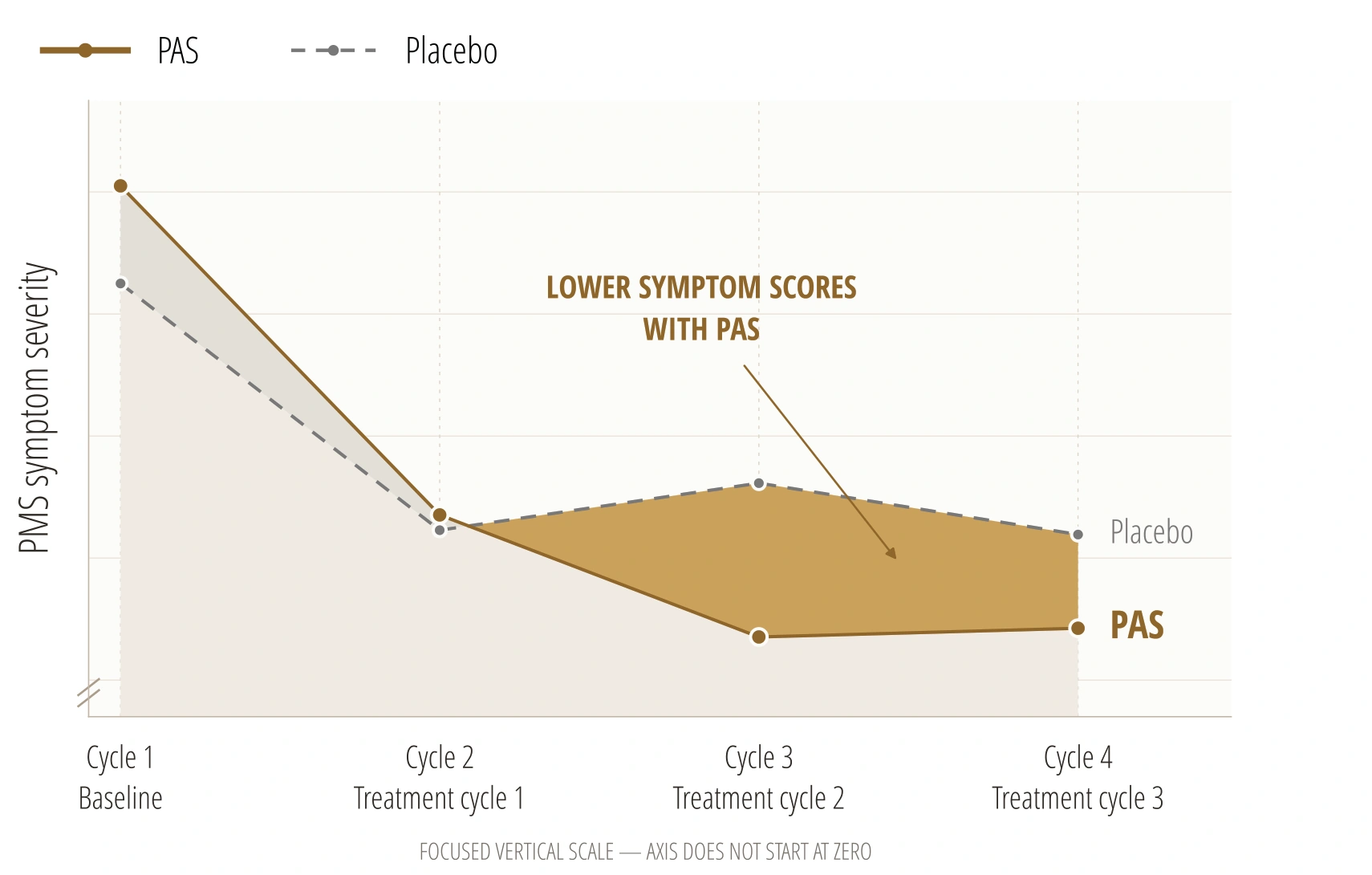
Read the publication ↗PMS symptom severity
Reduction in physical symptom scores
Reduction from baseline (%)
03 · Women’s health
Research across the menstrual cycle.
Tracking symptoms over time.
Overall symptom severity improved more with CognoLipid™ than with placebo (p = 0.001).
Looking beyond the total score.
The physical-symptom subscale improved more with CognoLipid™ (p = 0.002). Depressive-symptom, productivity and relationship outcomes did not reach conventional statistical significance.
Study details +
A randomized, double-blind, placebo-controlled trial studied 400 mg PS + 400 mg PA daily over three treatment cycles, following a baseline cycle. Forty women completed the study. Symptoms were recorded using the Daily Record of Severity of Problems (DRSP).
Schmidt et al. · Clinical Nutrition ESPEN · 2018
Read the publication ↗